As the global mining industry transitions from mature open-pit operations to deeper, more complex underground environments, the engineering challenges of safety, cost management, and environmental compliance have escalated exponentially. Among these, underground mine ventilation remains one of the most critical—and costly—operational necessities, frequently accounting for up to 50% of an underground mine’s total energy consumption.
Historically, ventilation was treated as a static utility: fans ran at full capacity, and air regulators or bulkheads were manually adjusted. Today, the industry is undergoing a digital transformation. With the rapid evolution of surface-to-ground control systems, automation, and industrial IoT, operators are moving away from fixed-output systems toward highly dynamic, data-driven Ventilation on Demand (VOD) control strategies.
By integrating precision topside monitoring with advanced underground infrastructure, mines are finally engineering smarter, safer, and remarkably efficient ventilation solutions.
The Complexity of Deepening Mines
Going deeper means confronting harsher environments. As a mine expands underground, operators deal with increased ambient rock temperatures, longer travel distances for fresh air, and higher concentrations of diesel particulate matter (DPM) and blasting gases.
Managing these hazards requires a level of precision that manual, localized adjustments simply cannot deliver. To maintain a safe working environment without sending operational costs into orbit, ventilation systems must be capable of routing precise volumes of air exactly where personnel and equipment are working—and scaling it back where they aren’t.
Topside Precision: The Rise of the SCADA
The true game-changer in modern VOD infrastructure is the capability of precision control from above ground. The industry is rapidly moving toward a single, unified Supervisory Control and Data Acquisition (SCADA) system—or similar overarching control platforms—capable of managing the entire underground ventilation ecosystem from a centralized surface command center.
Imagine a single “topside” interface that seamlessly controls and monitors:
- Main surface fans and underground booster fans
- Real-time gas, airflow, and temperature sensors
- Automated air regulators
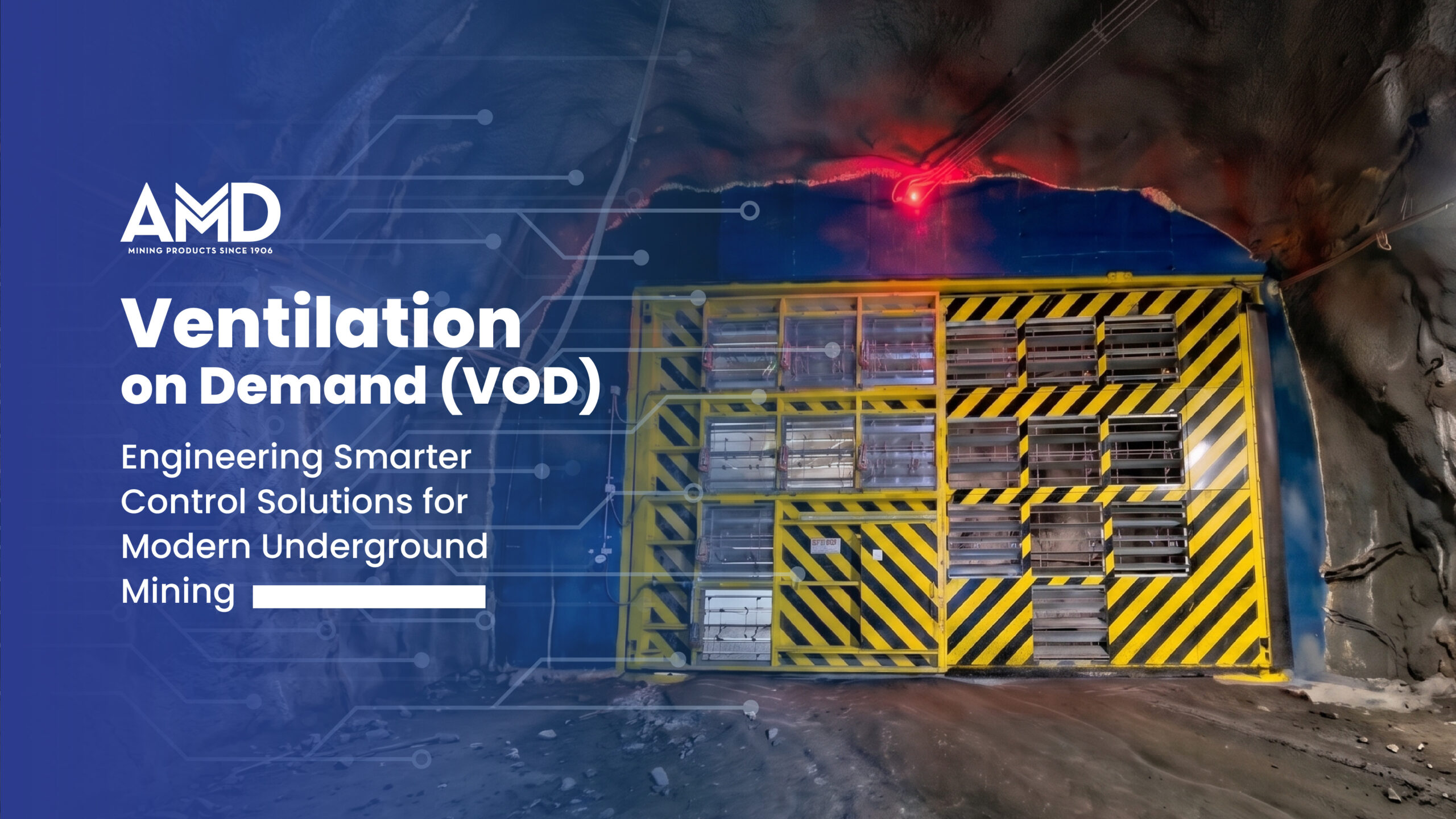
- Heavy-duty underground ventilation doors
When all these components communicate through a unified network, the system can dynamically adapt to real-time events. For instance, during a scheduled blasting cycle, the SCADA system can automatically adjust air paths to clear toxic fumes rapidly through the shortest possible route, all without risking human exposure or relying on manual underground interventions.
Engineering Tougher, Smarter Hardware: The Hybrid Solution
Software and surface controls are only as good as the rugged hardware operating in the harsh underground environment. Mine ventilation doors, in particular, must withstand massive water gauge pressures, heavy equipment traffic, and abusive blasting concussions.
Historically, mine operators faced a stark engineering trade-off: choose the brute, unyielding power of traditional hydraulic door actuators, or opt for the precise positioning and data feedback of electric motors.
| THE HYBRID ACTUATION PARADIGM | |
| HYDRAULIC POWER | ELECTRIC PRECISION |
| High-pressure robustnessResists blasting shock Reliable structural force | Digital positional feedbackSmooth speed modulation Infinite variable control |
The latest breakthrough in mine door engineering solves this dilemma by utilizing hybrid electric-hydraulic actuation. This innovative strategy pairs the physical robustness and high-pressure capacity of hydraulic cylinders with the digital precision of variable-speed electric motors. The result is an exceptionally durable door that can be throttled, modulated, and monitored with absolute precision, sending exact positional data back to the surface.
Eliminating Costly Human Error and Blasting Damage
One of the most persistent operational headaches in underground mining is the accidental destruction of ventilation infrastructure. It is an all-too-familiar scenario: a blast is initiated, but an underground crew forgets to manually open a critical ventilation door. The resulting concussive shockwave completely destroys the door, stalling production, disrupting the air balance, and costing tens of thousands of dollars in emergency repairs.
With state-of-the-art automation, this risk is entirely engineered out of the loop. Because the ventilation doors are tied directly to the topside control system, the surface operator can execute a pre-blast sequence that automatically opens the doors, verifies their status via digital feedback, initiates the blast, and clears the smoke—all with precision, digital certainty. No forgotten steps, no damaged doors, and zero unnecessary downtime.
Custom Integration: Becoming “VOD-Ready” with AMD
Implementing a VOD strategy doesn’t mean a mine has to scrap its existing infrastructure and start from scratch. The transition relies on smart, adaptable interfaces that bridge the gap between heavy underground machinery and advanced surface networks.
This is where custom-engineered control infrastructure becomes vital. American Mine Door (AMD) addresses this head-on by designing state-of-the-art Programmable Logic Controller (PLC) cabinets tailored to the specific needs of each operation.
Built to Connect: AMD PLC control cabinets are custom engineered to interface with whatever existing SCADA, communication protocol, or tracking system a mine currently utilizes.
Whether your operation relies on fiber optics, Leaky Feeder, Ethernet/IP, or Modbus, these smart control cabinets ensure your heavy-duty mine doors and regulators are fully integrated into the VOD loop. They provide the necessary edge intelligence to process sensor data locally while executing real-time commands dispatched from the topside command center.
As underground mining becomes increasingly complex, relying on legacy, fragmented utility controls is no longer viable. Engineering smarter solutions means looking at the mine as a single, living organism. By combining the unstoppable ruggedness of hybrid-actuated doors with the intellectual power of custom PLC cabinets and unified surface SCADA systems, modern mines are achieving unprecedented levels of safety, efficiency, and operational agility.
To learn more about optimizing your underground ventilation infrastructure and exploring custom, VOD-ready door solutions, visit the AMD website